
Security
How Access Control and Video Surveillance Support Modern Facility Security
Cameras record what happened. Access control governs what is permitted to happen. Facility security depends on both, working as layers rather than as separate installations.
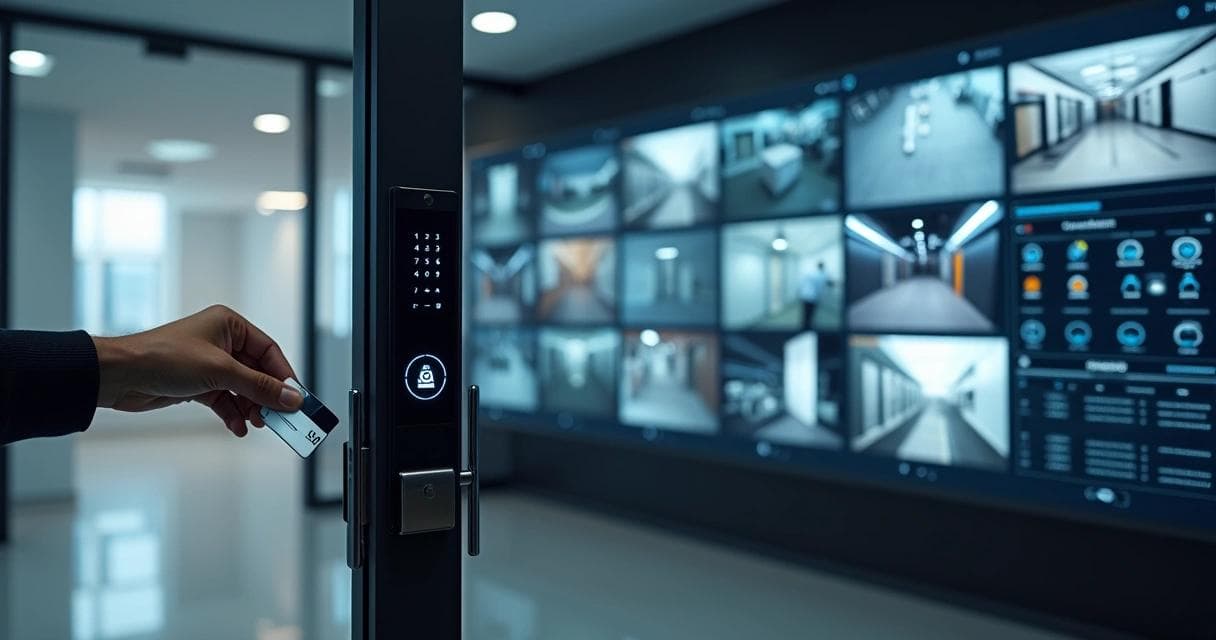
Controlled access and video monitoring in a commercial facility.
On This Page
Ask what secures a building and the answer is usually a device: a camera, a card reader, a gate. In practice no single device secures anything. What protects a facility is the relationship between several of them.
Access control and video surveillance are the two most common, and they answer different halves of the same question. This article covers what each does and why they are stronger together.
Modern Facility Security Requires Multiple Layers
A layered approach means protection applied at more than one point and in more than one form. The perimeter, the entrance, the interior, and the areas needing tighter control each present a different problem, and a measure suited to one is rarely suited to all.
Access control and surveillance are two layers within that approach — not the whole of it, but the two most present in daily operation.
What Is Access Control?
Access control governs who may enter which areas. Entry follows a defined rule rather than an individual judgement made at the door, and that rule is applied consistently regardless of who is on duty.
In practice this means readers at the doors and areas that need them, and a set of permissions that reflects how the organization actually works.
What Is Video Surveillance?
Video surveillance provides visibility. Cameras observe entrances, corridors, and shared areas, and what they capture can be watched now or reviewed later.
Surveillance does not prevent an event. It makes activity observable — which is a different and equally necessary thing.
Visibility and Controlled Access
Each capability has a blind spot the other covers. Access control knows that a credential was presented at a door; it does not know who presented it. Surveillance sees who walked through; it does not decide whether they should have.
Managing Restricted Areas
Some areas need more than the building's general protection — server rooms, plant rooms, storage holding valuable assets. These are where the combination matters most: access limited to those who need it, and coverage confirming what happened there.
Supporting Event Investigation
When something needs explaining afterwards, two records exist. Access activity gives a sequence of entries; recorded video gives what those entries looked like. Read together they answer questions that neither answers alone.
Access Records and Operational Visibility
Access activity accumulates into a record of movement through the facility — which doors, which areas, at which times. That record supports day-to-day operational visibility as much as it supports security review.
Building a Layered Security Approach
- 01Access Control
- 02Video Surveillance
- 03Monitoring
- 04Integrated Security Visibility
Conceptual relationship between security layers. Not a technical architecture.
The combination is not automatic. It comes from planning the layers against the same facility — its entrances, its layout, and the way people already move through it — rather than deploying each in isolation.
Conclusion
Access control without visibility governs entry it cannot verify. Surveillance without access control observes movement it cannot influence. A facility is better served when both are planned as parts of one approach, because that is how the questions asked of them actually arrive.